Hardanger
The Hardanger is a Norwegian fiddle ( hardingfele) and is often sited as the national instrument of Norway. It is similar to the violin in that it has four main strings. It’s 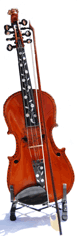 body however is larger and lying under the fingerboard are four or five sympathetic strings that resonate beneath the tones of the main strings. In this way Hardanger music is heavily polyphonic with Asian inflections created by its’ drone voice.
By the mid-1700s the Hardanger had become the dominant folk instrument in much of the south-central inland and western coastal areas of Norway. Researchers have notated over 1,000 distinct tunes, or slåttar, for the instrument. While the Hardanger is used in Norwegian folk and dance music it is most commonly associated with Norwegian bygdedans or regional dances such as springar and gangar. The Hardanger personifies one of the few European folk music traditions that have been able to survive the challenges of cultural change and foreign musical influences to continue nearly unchanged up to the present day.
A typical Hardanger Fiddle is beautifully ornate, decorated with mother-of-pearl inlay and rosing. At its’ crown is a carved head of an animal - usually a lion - or occasionally a maiden.
 Listen to the Hardanger
Dilruba
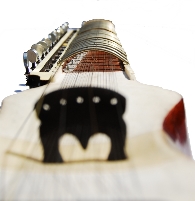
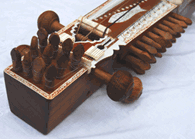
The Dilruba is an Indian classical instrument, the origins of which  date back at least two hundred years. The Dilruba is smaller yet very similar to the Sitar; It has a wide neck with frets, on which four strings sit and under which eleven sympathetic strings resonate. The sympathetic strings are tuned using five wooden pegs in the centre of the head of the instrument and the four ‘playing’ strings are tuned using metal pegs to the side of the head of the instrument. The ‘playing’ strings are sounded using a bow with convex tension and the fingering is the same as the sitar in that the frets are merely there as guides, allowing the player to see where the notes are positioned while giving them the freedom to slide between notes – thus creating the characteristic vocality of quarter notes and microtones.
The bridge is seated on a skin that is stretched over the hollow wooden body of the instrument. The Dilruba is played vertically like a cello, however its’ body is curved to allow the player to secure it between their knees. The combination of the sympathetic strings and hollow body produces a sound that is highly resonant and higher in pitch than the Sitar.
Listen to the Dilruba
Sarangi
The Sarangi is a small gut stringed instrument which was made poplar in the 17 th century by its extensive use in vocal accompaniment.
The name “Sarangi” is understood to mean "a hundred colours" thereby illustrating its versatility, its flexible tuning, and its ability to create a large pallette of tonal colour and emotional nuance. The Sarangi is venerated for its capacity to imitate the timbre and inflections of the human voice as well as for capturing the voice’s intense emotionalality.
The entire instrument is carved of a single piece wood. It has a sound board over which a goat skin is stretched - the bridge is 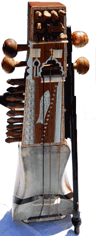 seated at its base. The Sarangi has three main, thick gut strings that are bowed. Lying beneath these strings are thirty to forty sympathetic strings. Eleven of those lie on two flat bridges near the pegs and are tuned to the notes of the raga. The remaining sympathetic strings are tuned on all the srutis - the interval between two different pitches - of each octave. In addition there is bronze rhythm string tuned to the tonic.
Unlike the violin, where the instruments’ strings are pressed down onto the fingerboard to sound a note, the playing strings of the Sarangi are sounded by the musician applying the pressure of his cuticle against the string. In this way the left hand is free to move up and down the side of the string achieving the quarter tones. Again the Sarangi requires a convex bow.
Listen to the Sarangi
Kemenche
A kemenche is like a rebec or fiddle from the Black Sea region of Asia Minor and it is the main instrument used in Pontian music. In Turkey this instrument is also known as the "Kementche of Laz". The Kemenche is bottle-shaped with three strings played in an upright position with a Doksar (bow.) It is sometimes played by resting it on the knee when sitting, otherwise it is held out in front.
Being only half a meter high and light weight allows the musician to be hold the Kemenche up for a long time. In some instances the musician will follow the first dancer around and may even dance as well!


.jpg)